Languages


- Cheese starter kits
- Dairy equipment
- Accessories and small equipment
- Cheese molds
- Molds for butter
- Rennets
- Starter cultures
- Moulds starters
- Starter cultures for yoghurt, kefir and probiotics
- Excipients, enzymes, salt
- Cheese coatings
- Packaging
- Pots, pans
- Transport and milk collection (churns, milking cups, containers, canisters)
- Zootechnics, animal husbandry
- Yoghurt makers
- Fruit Preparations
- Toppings and additives for ice cream, desserts, and cakes
- Spices
- Smoking
- Milking machines
- Elegant cheese boards and cutting boards
- Protective clothing, detergents, health and safety
- Services - logos, labels, leaflets, etc.
- Serowar.pl Sweets
- New products
- On sale
Payments

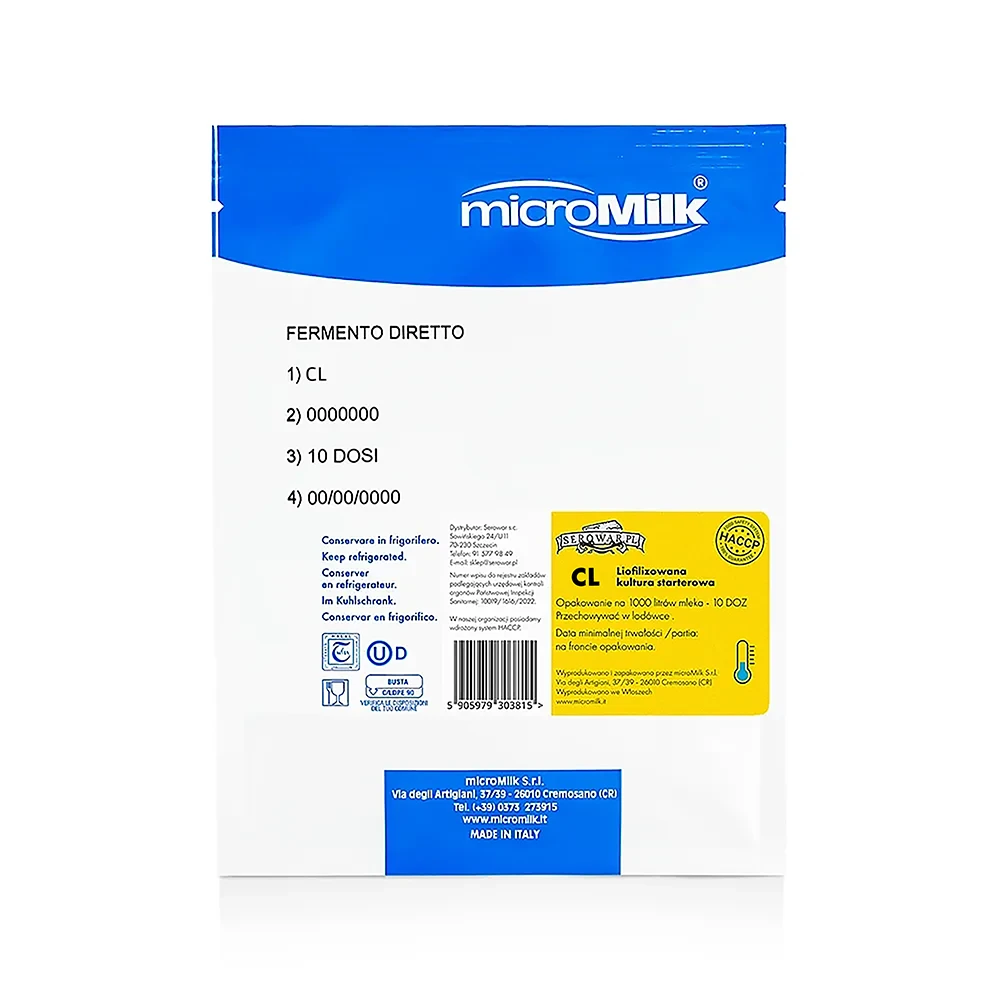
CL - supplementary starter culture for cheese (for 1000 l of milk)
Regular price:
product unavailable
add to wish list
Description
CL – a supplementary culture for developing cheese aroma
Cheese flavour and aroma begin to develop as bacterial cultures get to work. Choosing the right microorganisms helps shape the character of the finished product. CL by Micromilk is a supplementary culture with aroma- and gas-producing properties, intended for use alongside the main acidifying culture.
The role of CL in cheesemaking
The preparation contains Leuconostoc mesenteroides subsp. mesenteroides. It complements the basic culture blend, contributing to aroma development and gas production during fermentation.
The product characteristics rate these properties as follows:
- Aroma production: ★★★★★
- Gas production: ★★★★★
Gas production should be taken into account when planning cheese texture. The effect of the culture depends on the recipe, the other microorganisms and the production and ripening conditions.
A supplementary culture — use alongside an acidifying culture
CL is not a standalone main acidifying culture. Its role is to complement the aroma- and gas-producing profile of the culture blend used. Select it to suit your cheesemaking process, observing the temperatures and times specified in the recipe.
Pack yield
The sachet contains 10 manufacturer doses, each intended for 100 litres of milk. The entire pack is sufficient for 1000 litres of milk.
Directions for use
Add the culture directly to the milk intended for production. Then stir for a few minutes to distribute the preparation evenly. Adjust the amount of culture to the milk volume in accordance with the product dosage.
Storage and transport
Store at 2 to 5°C. According to the product information, the preparation tolerates ambient temperatures during transport. The recommended refrigerated conditions must be provided for subsequent storage.
GMO declaration
According to the product declaration, the preparation is not a genetically modified organism and has not been produced from genetically modified organisms as defined in Regulations (EC) No 1829/2003 and 1830/2003.
Inni klienci kupili również