


Many people interested in home cheesemaking do not realise how easy it is. They often give up before their first attempt, citing a lack of milk straight from a cow, a lack of time or simply a lack of confidence that it will work.
I would therefore like to show that any cheese can be made from milk bought in an ordinary grocery shop! Not just any milk, of course: to form a proper curd, it must have been gently pasteurised at no more than 75–80°C. Higher temperatures change the protein structure, weakening the action of rennet and preventing a curd from forming. Use refrigerated milk with a short shelf life, or fresh milk from a farmer if available.
You are also welcome to watch the instructional video on cheesemaking basics and a simple rennet cheese:
I will demonstrate using Mleczna Dolina milk from Biedronka. It is ideal because it is pasteurised at a low temperature. Buy the freshest possible milk, with the latest expiry date.


I pour the chilled milk into a pot and gently heat it to about 33°C. Heat slowly so the protein does not scorch. The milk needs to “come back to life”, so after heating I add a starter culture, such as MSE.


The bacteria need to get going and work for a while. After adding them, stir the milk thoroughly and wait about half an hour.
Milk loses calcium during pasteurisation, and calcium is needed for rennet to work properly. Replenish it with calcium chloride, a salt that also occurs naturally. A warning: some dishonest sellers offer ordinary food-grade calcium chloride rather than cheesemaking grade, or worse, technical-grade calcium chloride! Technical-grade material is used, for example, to de-ice roads in winter. Be wary if the price seems suspiciously low. Only purified 99% cheesemaking-grade calcium chloride is used for cheese. Buy from professional shops such as ours. We guarantee the highest quality and freshness, supported by appropriate certificates and approvals.

With the calcium chloride added, we can now add rennet. For beginners, liquid rennet in dropper bottles is easiest to dose. You can use traditional calf-stomach rennet or the more modern microbial type, produced from special mould strains. Both are 100% natural. For processed shop-bought milk, it is worth increasing the stated dose by 50%, or even doubling it.

After adding rennet, stir the milk and leave it undisturbed for about an hour.

A curd will have formed by then. Check its quality, and it is ready to cut.

The cut curd, or more precisely the curd grains, looks like this:

I turn on a low heat and warm the grains to about 38°C, stirring often. Whey continues to leave the grains and they shrink. This is optional and depends on the cheese you want to make.

Before transferring to the moulds, I wait about 10 minutes for the grains to settle at the bottom.


Meanwhile, I wash the cheese moulds…

…they are ready and waiting.
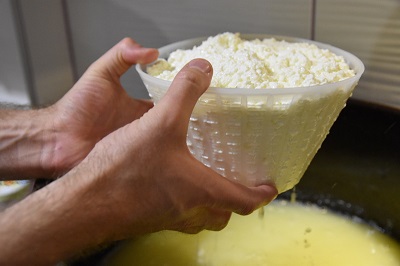
I transfer the clumped curd grains into them…


After filling the moulds, turn the cheese several times at intervals of about 15 minutes, then leave it at room temperature. Moulding should take about 12 hours. During this time the cheese knits together, excess whey drains, and bacteria slightly acidify it, preserving it and giving it its initial flavour.


Once the curd is out of the pot, I turn on the gas to heat the remaining whey. It still contains proteins, globulins and albumins, which would be a shame to throw away. I will turn them into delicious, delicate ricotta.

Meanwhile, in another pot, I prepare brine by adding salt to boiling water in a ratio of 1:5 (20% concentration).

Back to the whey, which is now very hot. Its ideal temperature is about 92°C.

When it reaches that temperature, I acidify it with apple cider vinegar.


Here is the ricotta that precipitates from the cloudy whey almost immediately after adding vinegar:

That is all for today. I leave the brine and the ricotta floating in the whey overnight to cool.
In the morning, our ricotta looks like this:

I pour the entire pot through cheesecloth or a fine sieve. The ricotta stays in the sieve: ready! Mix it with herbs and salt, or make it sweet with jam, for example. It makes an excellent sandwich spread. These proteins are much easier for the body to absorb than casein, making it a very healthy choice!

Now, back to the main stars:

I salt the cheese formed overnight for a few hours in brine cooled to room temperature. Three hours is enough for cheeses weighing about a kilogram.

Then the cheese goes into the refrigerator or cellar. It is ready to eat, though its flavour will change with time. Try a little over several weeks and watch its character develop.
You can also add any seasonings you fancy before putting the cheese in the mould!


Done!
Ten litres of shop-bought milk gave me almost 1.5 kg of cheese! Quite good, financially too: PLN 13.33 per kilogram… but that is not the whole story, because…

I also have almost 0.6 kg of ricotta, bringing the total to over 2 kg of homemade cheese for PLN 20, or about PLN 10 per kilogram. Add the cost of rennet, calcium chloride and any starter culture, of course, but the large packs last for many batches.
Flavour, satisfaction and health matter much more than cost!
We know our cheese contains no nasty additives or chemicals.
As you can see, making cheese at home is not difficult!
This cheese could informally be called Koryciński-style, because it is similar. In practice, it is the simplest rennet cheese, known by different names in different countries.
Cheesemaking is tremendous fun, and your own cheeses delight the eye and palate far more than even the most expensive, sophisticated shop-bought ones!
Be brave and try: I guarantee it is not difficult! ;-)