


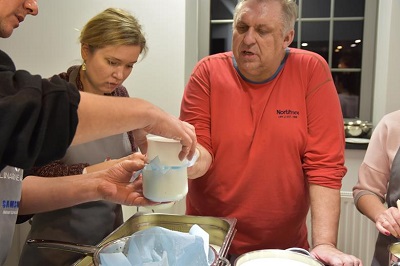
Cheesemaking workshops are ideal for beginners wishing to start making cheese at home. One such workshop took place on Saturday 20 February 2016 at Leszek Wodnicki’s Culinary Atelier in Szczecin.
Sixteen participants learned to make homemade Gouda under Gieno Mientkiewicz’s guidance. Cezary Szczupak also joined us with his outstanding cheeses from Kozie Frykasy farm. Jakub Krężel of Serowar.pl supplied the accessories and technical support.
You are warmly invited to read and enjoy our photo report!

We heated chilled milk from a farm near Szczecin to just over 30°C, stirring frequently to prevent the proteins scorching. At the target temperature, we added kefir to introduce bacteria that would flavour and preserve the cheese by establishing the right pH. Their activity also affects rennet, as we discovered: the kefir probably contained few active bacteria, so we waited a long time for sufficient acidity for the rennet to form a proper curd. We therefore recommend ready-made powdered starter cultures, with kefir as a fallback only if no starter is available.
We added rennet about 10–15 minutes after the kefir. We used convenient liquid microbial rennet from special fungi, in dropper bottles, at an optimal dose of one drop per litre of milk.


While waiting for a firm curd, Gieno prepared the first tasting: fresh cheeses with toasted poppy seeds and buckwheat honey.
Finger-licking good!


While we chatted, the curd became ready to cut. We slowly cut it into cubes with ordinary kitchen knives.
Cutting starts whey drainage and curd-grain formation. Cheesemaking separates the dry matter, mainly protein and fat, from the remaining whey, which is mostly water.
Stir the cut grains frequently so they do not stick together yet. They will knit in special moulds later, after more whey has drained and the grains are firm and compact.
For Gouda, hot water is also added now. This is called washing the curd: it dries the grains, because whey leaves faster at higher temperatures, and makes the flavour milder by washing out lactose.


When the grains are ready, transfer them into cheese moulds with an ordinary sieve. Line the moulds with cheesecloth so pressure does not push cheese into the holes and trap it. The cloth also helps removal. Press the filled mould with the lid supplied with this type of mould.
Ideally, Gouda should be pressed for about 12 hours under a few kilograms of weight for a roughly 250 g cheese. We shortened this greatly because time was limited. Less air and whey were expelled and the rind formed poorly, but that did not matter: the makers could hardly wait to eat their cheeses! Such defects could harm cheese aged for several months, since an uneven rind encourages mould in recesses that are difficult to wipe clean.


After removing the cheese, salt it in saturated brine or by rubbing it with salt. We used the latter because of limited time. Cheesemaking salt should be non-iodised: iodine inhibits the bacteria we need. Can ordinary iodised salt be used? Yes, it is not a disaster, but it is worth doing things as well as possible and according to good practice.
Salting gives flavour, slows bacterial activity, draws out excess water and develops a protective rind.
Rub the cheeses generously with salt and leave for several tens of minutes. Gently tap off the salt and leave to dry. At home, a refrigerator works best, though a cool cellar would be ideal.


While the cheeses salted, there was time for another tasting. Gieno prepared a dessert with Gouda-style cheese, smoked cheese, honey, nuts, apples and orange peel.


Freshly made cheese is still quite moist. Turn it frequently, even twice daily during the first week, so both sides dry evenly.
Two litres of milk gave cheeses weighing about 200–250 g, a standard yield for good-quality milk. Such small cheeses do not need long maturation: after a month their flavour becomes interesting and distinct.


Use the whey left after the main cheese to make whey cheese. Heat it to about 90–95°C and acidify with apple cider vinegar, for example. Globulins and albumins precipitate, forming a delicate cheese, excellent with herbs as a sandwich spread.


To conclude, I would like to mention the participants’ surprise. Most had never made cheese. They were amazed that the curd tasted sweet and mild, like warm milk. This is the basic difference between acid-set curd cheese and rennet cheeses made from fresh, sweet milk.
I had no idea this kind of cheese was so easy to make. We are accustomed to thinking that cheese, cured meats and so on are made in processing plants; that is what we are taught. Yet only a hundred years ago, much of this production was farm-based— said one workshop participant.

We invite everyone to try homemade cheesemaking. It is a wonderful way to spend an unusual evening, and your products will surprise and impress family and friends! Their flavour is unique, and the satisfaction of serving something you made yourself is enormous.
The workshop used accessories and ingredients available in our shop.