


Annatto – A natural plant extract used to colour cheese.
Corrosion-resistant material – A material that does not deteriorate or react with acid.
Red smear bacteria – See Brevibacterium linens.
White mould – See Penicillium candidum, Penicillium camemberti and Geotrichum candidum.
Whey proteins – Milk proteins that do not coagulate when rennet is added. They remain in the whey, which can be heated to produce whey cheeses such as ricotta.
Brevibacterium linens – Red smear bacteria that grow on smear-ripened cheeses such as Limburger and Brick cheese, giving them their characteristic sharp flavour.
Calcium chloride – A white substance derived from calcium carbonate, used to aid curd drying and make the curd firmer. It occurs naturally.
Skimmed milk – Milk with most of the cream removed. Fat content: 1–2%.
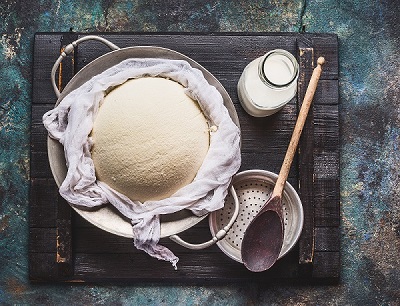
Cheesecloth – A fairly loosely woven cotton, linen or synthetic cloth used, among other things, to drain curd and line cheese moulds.
Cheese board – A knot-free ash, maple or birch board, 15 cm square and 2.5 cm thick, often used to drain cheeses such as Camembert. Larger boards are used for maturation.
Maturation – The stage when cheese rests at a specified temperature for a specified time to develop the flavour and aroma characteristic of its variety.
Cheese colouring – Annatto added to milk before renneting to give cheese various shades of yellow. It comes from the fruit of the tropical tree Bixa orellana, grown in the Caribbean, Brazil and India.
Food wrapping film – Cellophane with controlled permeability, used to wrap cheese.
Coulommiers mould – A stainless steel mould consisting of two rings, one inside the other, used for Coulommiers cheese. A one-piece Camembert mould may also be used.
Moulding – Placing curd in a cheese mould, which gives the cheese its final shape and assists drainage.
Geotrichum candidum – A white mould used for many soft mould-ripened cheeses, such as Camembert and Brie, producing a delicious white rind.
Direct-set starter cultures – Ready-to-use bacterial strains added directly to milk, eliminating the lengthy preparation of a bulk starter or mother culture. They help milk proteins set into a firm white jelly-like mass from which cheese is made.
Homogenisation – Breaking up milk fat particles so that they are evenly distributed and cream does not rise to the surface.
Junket – A weak form of rennet.
Casein – The main milk protein, which coagulates under the action of rennet and forms the basic component of cheese.
Coagulation – The point at which milk sets into a substance with a firmer consistency.
Cutting the curd – Cutting the coagulated milk into cubes of equal size.
Mother culture – A culture containing live bacterial strains that can be propagated and used to acidify milk, resulting in curd formation.
Lactic acid – Acid produced in milk during cheesemaking. Starter bacteria ferment milk sugar, lactose, into lactic acid.
Acidity – A chemical measure of how acidic milk is. It develops through starter bacteria and causes milk proteins to come together as curd.
Acid curd – Curd formed by acidifying milk.
Lactose – Sugar naturally present in milk, making up as much as 5% of its total weight.
Lipase powder – An enzyme added to milk to give cheese a more pronounced flavour.
Draining mat – A reed or plastic mat used for draining and maturing cheese.
Mesophilic starter cultures – Bacterial strains that ferment lactose into lactic acid and thus acidify milk. Used for cheeses made at 39°C or below.
Top-stirring – Stirring the upper 0.5 cm of non-homogenised milk just after adding rennet to prevent cream rising to the surface.
Raw milk – Milk straight from a farm animal that has not been pasteurised.
Milk powder – Dehydrated, concentrated milk. It can be mixed with water to make liquid milk and is also used to thicken yoghurt.
Muslin – A very fine cotton fabric used to drain cheese.
Follower – A flat stainless steel, plastic or wooden disc placed in a cheese mould to distribute press pressure evenly. Usually sold with the mould.
Saturated salt solution – Brine in which cheese is soaked. A solution is saturated when added salt no longer dissolves. Approximately 20%: 1 kg salt per 5 litres of hot water.
Blue mould – See Penicillium roqueforti.
Curd knife – A long-bladed knife that reaches the bottom of the curd container. It should have a rounded, rather than sharp, tip.
Draining – Separating whey from curd. Before draining, place the curd and whey in a cheesecloth-lined mould.
Milk deposits – Milk residues that build up on cheesemaking equipment after prolonged use. Cleaning with the special products available in our shop is recommended.
Drying – Leaving cheese to develop a protective rind before maturation.
Bandaging cheese – Wrapping cheese in cloth and coating it with fat to retain the desired shape and rind and prevent moisture loss.
Food-grade paraffin – Low-melting-point paraffin used to protect cheese from drying and cracking. Most hard cheeses are paraffin-coated.
Paraffin-coating and waxing – Covering cheese with wax to stop the rind drying and discourage mould growth.
Pasteurisation – Heating milk to 63°C for 30 minutes to eliminate potentially harmful pathogens.
Penicillium camemberti (P. album) – White mould grown on some mould-ripened cheeses, such as Camembert and Brie, producing a delicious white rind.
Penicillium candidum – White mould grown on many mould-ripened cheeses, such as Camembert and Brie, producing a delicious white rind.
Penicillium roqueforti – Blue mould grown on the surface and inside many blue cheeses, including Stilton and Gorgonzola.
Heating the curd – Heating curd grains to expel more whey.
Direct heating – Heating milk directly on a cooker hob.
Indirect heating – Heating cheesemaking milk in a water bath by placing its pot in a bowl or sink of hot water.
Rennet – An enzyme that coagulates protein. Animal rennet comes from the stomach of a calf or lamb fed on its mother’s milk. Vegetarian, or microbial, rennet contains no animal protein.
Ash – Activated charcoal used to neutralise the cheese surface and create favourable conditions for mould growth.
Pressing – Placing curd in a cheesecloth-lined mould and pressing to remove excess whey.
Cheese trier – A stainless steel tool for removing a cheese sample to assess its maturation and readiness to eat.
Rewrapping cheese – Changing or washing the cloth around cheese during draining and pressing to prevent sticking. Washing is also required with KADOVA moulds, which have an integrated mesh.
Milling – Breaking curd into smaller pieces before pressing.
Proper grain separation – A term used in Swiss cheesemaking. To check whether grains have been heated enough, gently rub a handful between your fingertips. The mass should readily break into separate grains.
Cheesemaking starter cultures – Bacterial strains added to milk at the first stage. They multiply, ferment lactose into lactic acid and acidify the milk. Starters are divided into mesophilic and thermophilic types.
Whey – The liquid produced after milk proteins coagulate. Whey consists of milk, milk sugar, proteins and minerals.
Smear-ripened cheeses – Cheeses matured with primary bacteria and surface cultures that give them a distinctive flavour and smell, such as Limburger and Brick cheese.
Soft cheeses – High-moisture cheeses that are not pressed and are either unripened or matured only briefly.
Mould-ripened cheeses – Cheeses with mould on the surface and/or inside. The two most common types are blue mould in blue cheeses and white mould in Camembert-type cheeses. See also Penicillium roqueforti and Penicillium camemberti.
Hard cheeses – Cheeses with a firm, compact texture and very little moisture. Pressing and maturation vary by variety.
Curd – The firmer, thicker consistency obtained by adding rennet to milk. It contains most milk proteins and fat.
Oiling – Applying vegetable oil to the cheese surface to protect against drying.
Salting – Adding salt to curd before placing it in the cheese mould.
Mother-culture starter – Live bacterial strains that can be propagated and used to acidify milk, resulting in curd formation.
Refined salt – Purified, non-iodised food salt.
Draining tray – A tray placed under the mould during pressing, allowing whey to drain into a sink or another container.
Thermophilic starter culture – Bacterial strains used for cheeses made at high temperatures, such as Italian and Swiss cheeses.
Dairy thermometer – Usually a probe thermometer that can be immersed in milk to measure its temperature during cheesemaking.
Fat – The fat or cream content of milk, ranging from 2.5% to 5.5% of its total weight.
UHT milk (Ultra Heat Treated) – Long-life milk briefly treated at a very high temperature, 134–150°C.
Ultra-pasteurisation – Treating milk at a very high temperature to extend its shelf life. See UHT.
Acidifying milk – The stage when live bacterial cultures ferment lactose.
Renneting milk – Adding rennet to milk to form curd.
Clean break – The stage when curd is ready to cut. Insert a thermometer or clean finger at a 45° angle. If a clear, straight split forms around it, the curd is ready for cutting.