


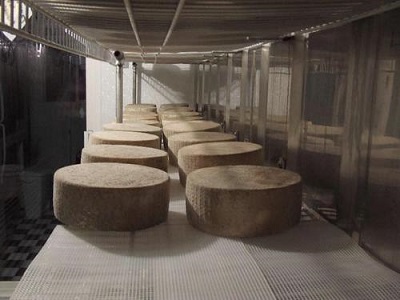
During this stage, cheese develops the flavour and character typical of its variety. Maturation can take a few days or as long as six years. The temperature and humidity of the room where the cheese rests must be carefully controlled. The right temperature is very important for the development of the bacteria added to the milk at the beginning. Their growth provides sufficient acidity to preserve the cheese. Most cheeses need a temperature of 8–16°C and a fairly humid environment, at 75–95% relative humidity. A key part of maturation is the continuous exchange between gases released by the cheese, including carbon dioxide and ammonia, and oxygen in the atmosphere.
For home maturation, a room where the temperature generally stays below 20°C is more suitable than a refrigerator. If the air is too cold, the starter culture will not develop sufficiently and the cheese will not turn out well. If it is too warm, the finished cheese will taste excessively sharp and astringent, and its texture will also suffer. Unwanted mould may develop, requiring more frequent checks. Mould can also grow if humidity is too high. On the other hand, if humidity is too low, the cheese may shrink and its surface may crack. Small cracks can be treated by rubbing on a little butter. The precise maturation conditions depend greatly on the type of cheese.
Soft cheese
Soft cheeses are usually not matured, but you can occasionally experiment by pressing and maturing one of your batches. Some recipes, for example those for Gervais and Bondon, include information on pressing and maturing soft cheeses.
Hard cheeses
Store hard cheese on a clean cheese board in a place maintained at 12.5°C and 65–85% relative humidity. Most cellars meet these conditions. You could also consider buying an inexpensive commercial cooler or an ordinary refrigerator. Put a bowl of water on the bottom shelf, set the temperature to 12.5°C and you have an ideal home maturing cabinet. During the first few weeks, turn the cheese every day; afterwards, a few times a week is enough. Turning prevents liquid from collecting at the bottom of the cheese and consequently prevents rot. The longer cheese matures, the stronger its flavour becomes. For most hard cheeses, this takes at least 60 days. Some cheeses, such as Parmesan, may mature for several years to develop a very sharp flavour. Inexperienced cheesemakers are often tempted to taste their work before maturation is complete, but patience is worthwhile: wait for a truly delicious result.

Sampling hard cheese
After a month or longer, you can use a cheese trier to check whether the cheese has matured. At cheesemaking competitions, judges use this tool to assess flavour, aroma, acidity, fat and moisture content, texture and the firmness of the cheese.

Insert the trier into the side of the cheese, noting the resistance of the cheese paste. Remove a small piece and roll it between your fingers. Smell and taste the cheese warmed in this way; at this stage, the smell of spoiled cheese is easy to detect. Replace the cheese plug in the hole and seal the gap around it by smearing on a little of the cheese warmed between your fingers. If necessary, leave the cheese to mature further.
Smear-ripened and mould-ripened cheeses
These cheeses mature in cool, humid rooms to encourage vigorous bacterial growth both on the surface and inside the cheese. Typical conditions are 7°C and 85–95% relative humidity. A detailed description of maturation techniques for smear-ripened and mould-ripened cheeses can be found on our website.